
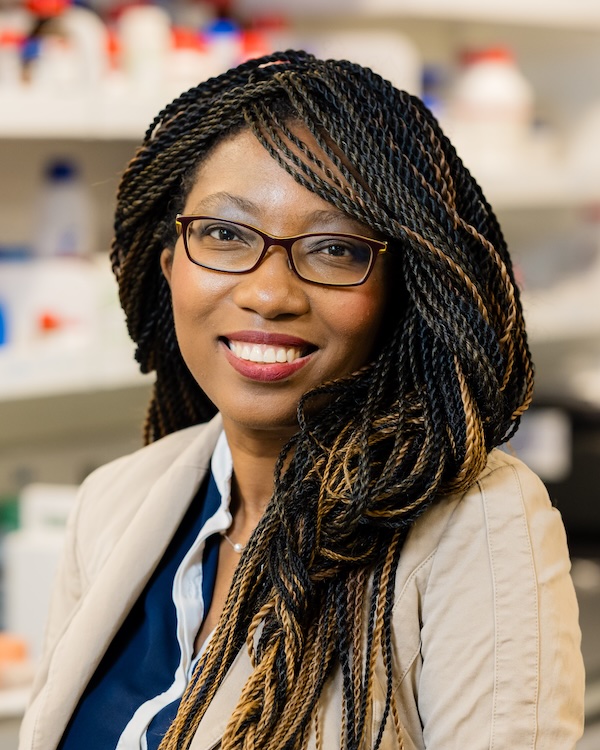
Ludmilla Aristilde promoted to Full Professor
January 20, 2026
We are delighted to share that Dr. Ludmilla Aristilde was promoted this fall to full professor in the Department of Civil and Environmental Engineering. She is also faculty by courtesy in the Department of Earth, Environmental, and Planetary Sciences, core faculty for Northwestern’s Center for Synthetic Biology, and a faculty affiliate of the Trienens Institute for Sustainability and Energy and the International Institute for Nanotechnology.
Professor Aristilde is an esteemed molecular biochemist and environmental chemist who studies microbes and minerals in soils. Her research tackles a wide range of questions about how organic materials behave in the environment.
For example, her lab group’s experiments have identified microbes that can break down microplastics in water, pointing to a potential biological solution to the ubiquitous problem of plastic waste.
“We can learn from nature how to engineer sustainable solutions,” Aristilde said in a 2024 interview with the Chicago Sun-Times.
Other recent work by Aristilde’s team has illuminated mechanisms for carbon and phosphorus cycling in soils – with implications for climate change and agriculture.
“We have shown for the first time that iron oxides in soil and sediment samples facilitate the cleavage of phosphate from ribonucleotide, thus catalyzing abiotic phosphorus recycling,” she explains. “This process is now being widely considered a missing piece in the phosphorus cycle.”
Born in Haiti, Professor Aristilde has an international perspective and a passion for science that addresses environmental challenges. She embraces collaboration and has held a Fulbright fellowship in France and was awarded the Alexander von Humboldt Foundation Bessel Research Award for a sabbatical in Germany. She was a tenured faculty member at Cornell before she moved to Northwestern in 2019.
At Northwestern, Professor Aristilde co-chairs a National Science Foundation-funded Research Experience for Undergraduates (REU) program through the Center for Synthetic Biology and is co-chair of the Organization for Women Faculty. She collaborates with fellow DEEPS faculty, reporting that “my colleagues and friends in DEEPS are wonderful to interact with.”
Intriguingly, Aristilde is an artist who holds a Bachelor of Fine Arts degree alongside her degrees in Earth systems, civil and environmental engineering, and molecular toxicology.
Artistic approaches have played an important role in her scientific discoveries. “The way I investigate scientific questions involves being creative,” she says, pointing out how envisioning unconventional combinations of techniques has repeatedly led her to “create an unexpected picture of the answers to questions.”
Congratulations, Professor Aristilde, and thank you for your many contributions to our community.