New Workflows Increase Efficiency of Seismic Noise Processing
March 13, 2026
A recent study offers simple, faster ways to robustly process everyday seismic noise for creating detailed maps of underground structure or changes therein.
Scientists use ambient-noise tomography to “see” inside the Earth without waiting for earthquakes. They record the planet’s constant low-level vibrations — caused by ocean waves, wind, and human activity — at many seismometer stations. By combining recordings from pairs of stations, they build virtual waveforms called empirical Green’s functions (EGFs). These act like snapshots of how seismic waves travel underground, helping map the crust and uppermost mantle, and are sometimes used to map temporal changes in them.
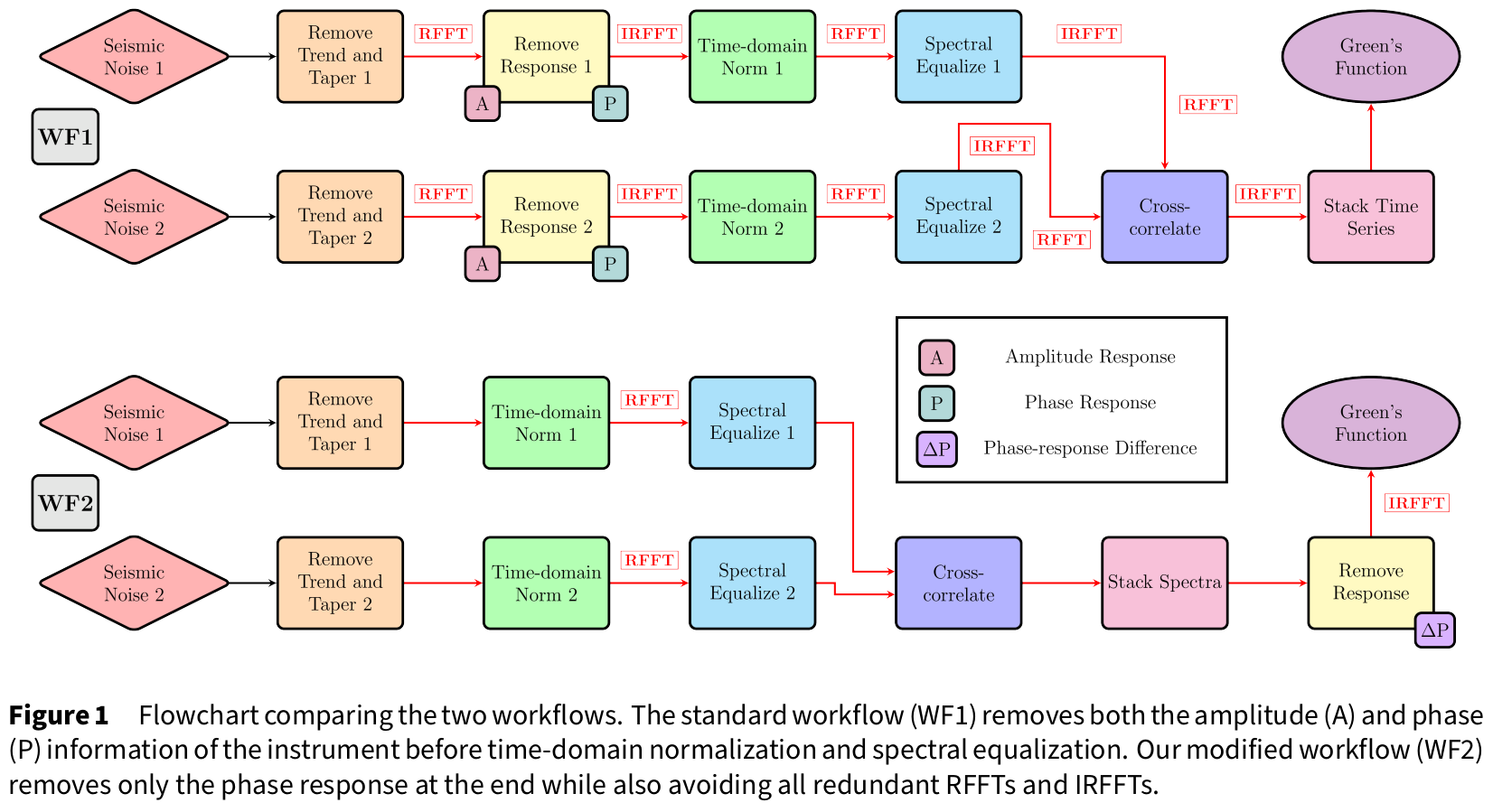
A standard step in this process is correcting for how each seismometer itself slightly distorts the signal (the “instrument response”). Normally, researchers fix both the strength and timing of that distortion right at the start, before any other processing. This step can be slow, complicated, and sometimes creates errors in frequency ranges where the instruments are less sensitive.
The new workflows from the recent study, published in Seismica, make this much more efficient and robust. They remove unnecessary repeated calculations, combine several processing steps into one quick operation, and — most importantly — apply only the essential timing (phase) correction once at the very end, after all recordings have already been combined. Because other steps in the workflow already remove most unwanted amplitude information, this simpler final correction is enough, avoids potential errors, and saves a lot of time.
Tests on real data from Southern California, Brazil, and Uganda show the main new workflow (called WF2) runs 67–75 % faster than the traditional method for individual station pairs. A more scalable version (WF3) that reuses calculations across many station pairs is 15–60 times faster for typical research networks. Even adding just one small change to existing software gives an immediate ~10 % speed boost and makes the results more stable.
The new EGFs look almost exactly the same as those from the old method. “We find that these optimizations produce EGFs that are nearly indistinguishable from the standard approach,” says lead author Caio Ciardelli. “Our goal was not only to benchmark the effects of various kinds of workflow optimizations used by the community and introduce a new one, but also to make these easy to understand and implement, making them accessible to early-career researchers, especially those in countries with little support for high-performance computing.”
Caio Ciardelli collaborated with DEEPS graduate students Albert Kabanda and Yoweri Nseko on this study. Caio is now a researcher in the Computational Seismology Group at the University of São Paulo. The study was conducted while he was a postdoctoral researcher in the Seismology Group, Department of Earth, Environmental, and Planetary Sciences at Northwestern University. The complete Python code, example datasets, and step-by-step instructions are freely available on Zenodo for anyone to use.