
Tiny crystals, big impacts: Advanced microscopy unlocks hidden records of cosmic collisions
August 12, 2026
The smallest minerals can tell some of the biggest stories. Some meteorites preserve records of high-velocity collisions that occurred early in our solar system, but these events happen in mere seconds and leave behind rare and unstable crystals only a few micrometers in size, creating opportunities to develop advanced electron microscopy techniques able to decode their messages.
A new study led by Ph.D. candidate Tirzah Abbott has uncovered new details about how minerals transform during catastrophic asteroid impacts. Published in American Mineralogist, the work reveals that multiple mineral transformation mechanisms can occur during a single impact event, leaving behind a rich micro-landscape not known in terrestrial rocks.
Abbott and collaborators studied the Catherwood meteorite, which was originally discovered in 1965 in Saskatchewan, Canada. The meteorite is known for having been heavily shocked, likely during an impact. “These shocked meteorites preserve snapshots of processes that happen incredibly quickly and under extreme pressure-temperature conditions we can hardly imagine,” Abbott said. “We're essentially using meteorites as natural laboratories to understand how materials behaved during the violent collisions that were common during the formation of the early solar system.” Shockwave experiments in the laboratory can reach similar pressure-temperature conditions, however it’s currently impossible to recover any material from such highly energetic experiments in the lab. In nature, such examples fall from the sky.
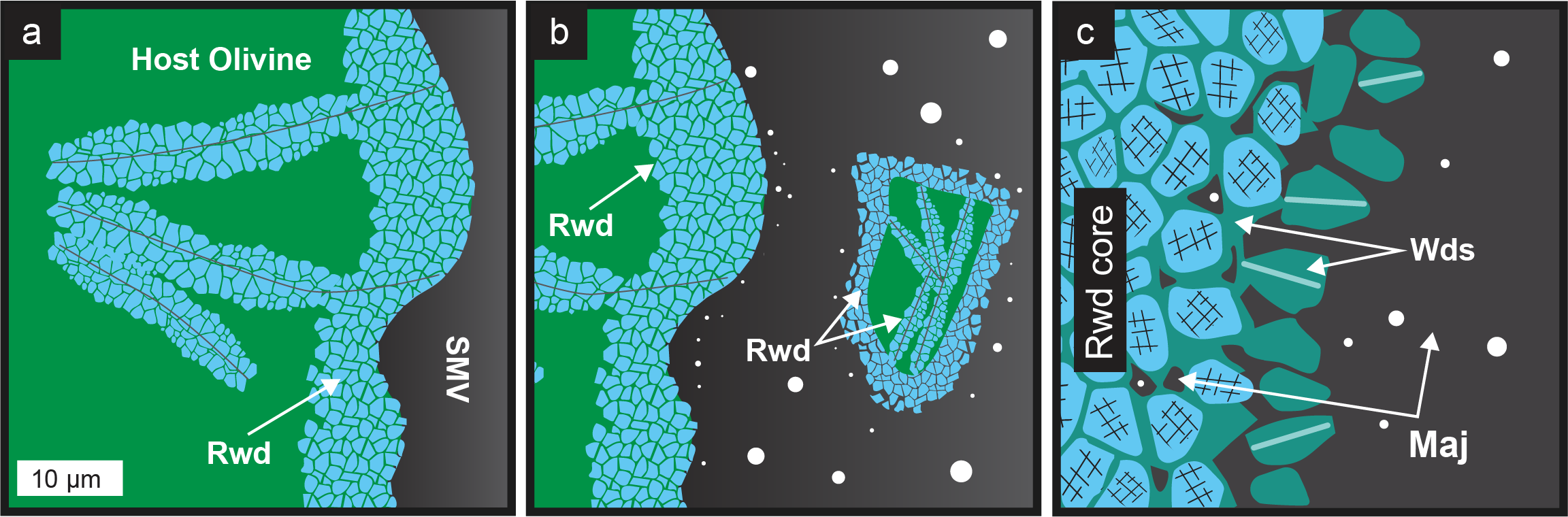
Scientists have known for decades that two high-pressure minerals, ringwoodite and wadsleyite, can form in the shock-melted veins found in some of these meteorites. Wadsleyite and ringwoodite, both high-pressure forms of the mineral olivine, have different stability fields so it has been a mystery why they are sometimes found together in the same shock vein. Exactly how this happens has remained a longstanding mystery. The high-pressure crystals are extraordinarily small, often smaller than the width of a human hair, and the techniques that can observe them at the nanoscale but also across larger fields of view are only now being developed.
To solve this, the team used an emerging microscopy technique that bridges a gap between traditional electron microscopy methods. The approach allowed researchers to study larger regions of the meteorite to understand spatial relationships between phases, while still resolving details at the nanometer scale, connecting tiny mineral grains to the larger structures surrounding them.
The analyses revealed that ringwoodite and wadsleyite do not form through a single process. Instead, multiple transformation mechanisms can occur within the same shock-melt vein during different stages of an impact event.
“Many studies have suggested that these high-pressure minerals record a single transformation process because of the incredibly short timeframe of these events,” Abbott said. “Instead, we found that multiple mechanisms can operate simultaneously over extremely short timescales within a single shock-melt vein.”
Understanding how these transformations occur helps scientists reconstruct the violent collisions that processed planetary materials billions of years ago. Because meteorites preserve these records at microscopic scales, advances in electron microscopy are opening new opportunities to study the earliest stages of our solar system in unprecedented detail.
The study also highlights how these approaches can benefit researchers far beyond planetary science.
The ways in which asteroids behave under shock loading is also important to planetary defense. The National Nuclear Security Administration, the agency which funded the research, runs a large program focused on improving 3d simulation codes for such impacts, requiring detailed information on the composition, mineralogy, material strength, and equations of state to improve damage and failure models.
“Beyond the meteorite story, what's exciting is that this approach can be applied across many areas of science,” Abbott said. “By leveraging Scanning Electron Microscopy (SEM) that is already available in many shared research facilities, we can expand access to powerful crystallographic tools and enable researchers across disciplines to answer questions that were previously out of reach.” In addition to working towards her Ph.D. degree, Tirzah is also the manager of the SEM facility at the NUANCE Center at Northwestern.
The paper, “Revealing Multiple Ringwoodite and Wadsleyite Transformation Mechanisms in a Shock-Melt Vein Using Transmission Kikuchi Diffraction,” was published in American Mineralogist.